Cinnamon Energy is a California-based installer who is taking an innovative approach to one of the biggest shifts in residential solar: the move toward third-party ownership (TPO) and financing-led growth.
As market dynamics push installers away from cash deals and toward more complex financing structures, many companies are struggling to keep up with the operational demands that come with this new reality.
Cinnamon saw this shift early and made a deliberate decision; don’t just adapt to TPO. Build a system that thrives on this new mode of financing and has scale built into it.
“We’re trying to build something that can repeat success, not just achieve it once.”
– Paras Shah, VP of Service and Logistics, Cinnamon Energy
Rather than bolting on new financing workflows onto existing processes, Cinnamon is redesigning its solar operations to be driven from the ground up by TPO financing requirements. This is a strategic move that is already positioning Cinnamon for scalability and growth.
The Operational Challenge Behind TPO Growth
TPO introduces a new level of complexity that most installer workflows were never designed to handle.
Each project requires extensive documentation that adheres to each TPO’s unique intake and validation requirements, and precise coordination across sales, operations, and field teams.
In many cases, a single contract can involve dozens of pages and highly specific data inputs that must be captured and submitted correctly.
As Paras explains, the sheer volume and precision required quickly becomes a bottleneck without the right system in place:
“We’re talking about 60-something pages, and you have to dot every i.”
— Paras Shah, VP of Service and Logistics, Cinnamon Energy
Even small errors can delay approvals, disrupt project timelines, and impact cash flow.
For example, missing a required inverter serial number, submitting photos in the wrong format, or capturing incomplete roof data can result in rejected submissions or delayed funding.
Without early validation, teams often move projects forward based on sales criteria rather than financing requirements, only to discover later that a roof type, system design, or customer qualification does not meet TPO standards. By that point, design work has started, install capacity has been allocated, and the project may need to be reworked or canceled entirely.
This breakdown often starts at intake, where critical financing data is simply never captured:
“There’s going to be probably 30 to 40% of items on this document that were never, ever captured by the sales rep on the front end.”
— Paras Shah, VP of Service and Logistics, Cinnamon Energy
For installers trying to scale, this creates a compounding problem. More deals mean exponentially more complexity. The compounding of manual steps, errors, delays & rework across projects coalesce to seriously limit companies’ ability to break through their capacity ceiling.
Building a System to Scale TPO Execution
To overcome the complexity of TPO, Cinnamon moved away from manual coordination and built a system that guides execution across every stage of a project.
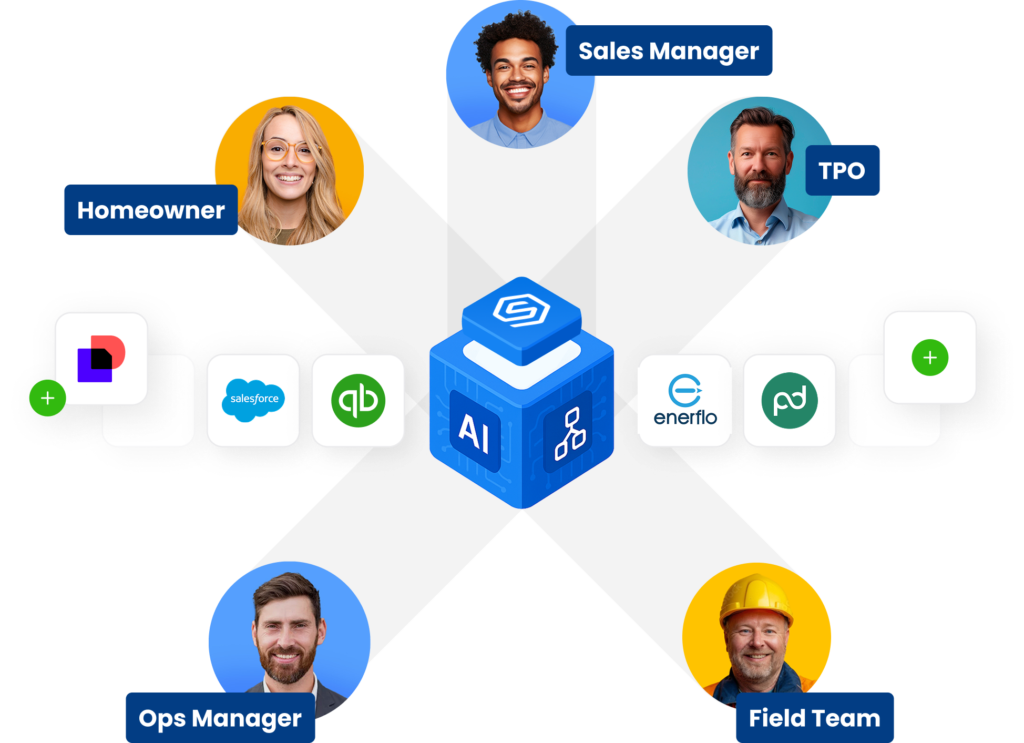
Using Scoop as their Central Operations Hub, they connected tools, teams, and workflows into a single execution layer where data flows automatically, work is structured through defined stages, and requirements are enforced at every step before projects move forward.
This system enables Cinnamon to automate critical parts of TPO execution, including finance application data capture, validation, documentation, and submission readiness, ensuring that every project is complete and compliant before reaching financing.
Instead of sales entering partial data and ops reworking it later, project information is captured once and carried through the entire workflow. Required fields are enforced at intake, validation happens before progression, and field teams are guided to capture exactly what is needed, such as specific installation photos, equipment details, and compliance documentation, in the correct format.
Rather than relying on teams to manage complexity, purpose-configured workflows guide execution, enforce consistency, and eliminate rework, improving both speed and reliability.
As Paras describes it, the system acts as a “nervous system” for the business, where actions in one part of the operation inform and support everything else.
“It’s not about removing people from the process. It’s about giving them a system that guides what needs to happen.”
– Paras Shah, VP of Service and Logistics, Cinnamon Energy
This approach allows Cinnamon to maintain control as they scale, continuously refining workflows as requirements evolve without introducing operational strain.
Scaling TPO Without Operational Strain
Delivering Consistency at Scale
With the complexity of TPO already embedded in their process, Cinnamon focused on making execution repeatable and controlled.
Using Scoop, they built structured workflows that guide how projects move forward, ensuring that required data, documentation, and validation steps are completed before progressing.
Instead of relying on teams to interpret requirements across multiple systems and lengthy contract packages, the process is enforced directly within the workflow:
- Required data is captured at intake and carried through the project lifecycle
- Validation happens before work progresses, not after issues surface
- Field teams are guided to capture specific documentation, such as installation photos and system details, in the required format
This reduces reliance on manual coordination and helps ensure that each project meets financing requirements before submission.
Supporting a More Scalable Operation
TPO introduces a significant increase in documentation, coordination, and validation requirements. Without a structured system, this typically leads to more manual work and growing pressure on internal teams.
Cinnamon approached this by designing their workflows to absorb that complexity.
Instead of adding more people to manage paperwork and submissions, they focused on:
- Eliminating duplicate data entry across systems
- Reducing back-and-forth between teams to fill in missing information
- Structuring how data and documents are captured so they are usable downstream
At Cinnamon, the goal was not to remove people from the process, but to give them a system that guides what needs to happen.
This allows the team to handle increasing TPO volume without relying on manual effort at every step.
Protecting Speed, Accuracy, and Cash Flow
One of the biggest challenges with TPO is the impact of small errors. Missing fields, incorrect formats, or incomplete documentation can lead to rejected submissions and delays.
By embedding requirements directly into the workflow, Cinnamon reduces the likelihood of these issues occurring downstream.
Projects are structured so that:
- Required inputs are captured before moving forward
- Documentation is collected in a consistent format
- Teams are aligned on what is needed at each stage
This shifts the process away from reactive fixes toward more controlled execution, helping avoid repeated rework and submission issues.
Building for What Comes Next
TPO requirements, financing partners, and documentation standards are continuously changing. Rather than building fixed processes, Cinnamon focused on creating a system they could adjust over time.
With Scoop acting as a central layer, they can:
- Modify workflows as requirements change
- Adjust how data is captured and validated
- Refine processes based on what is working and what is not
This allows them to continue improving how they manage TPO without needing to rebuild their operations from scratch.
By combining a clear operational strategy with Scoop’s Central Operations Hub, Cinnamon is building a model defined by how effectively they can execute, scale, and adapt.