


While rooftop solar panels make a visible statement that a homeowner is an environmental steward and interested in improving utility consumption, residential energy storage systems provide real control. And that’s what residential battery brand FranklinWH aims to do — offer a suite of products that give households more control of their energy usage. The “WH” in the company name stands for “whole home,” and CEO Gary Lam said helping homes with their energy usage starts with energy storage. The flagship aPower system can store power from multiple sources, has a 15-year warranty and supports the company motto of “Energy Freedom.”

FranklinWH CEO Gary Lam and SPW editor Kelly Pickerel
“There are a lot of phrases out there about energy — like resiliency and independence,” Lam said. “If you guarantee your energy, that’s resiliency. Energy independence is generating your own energy. When you get to energy freedom, you have everything. Our systems are not controlling your energy consumption. You can use any source without worrying about how much it costs. We are providing the ultimate energy freedom to people.”
Also important to FranklinWH is the “Made in USA” distinction of its energy storage systems. Solar Power World toured two FranklinWH production sites in California and saw how local manufacturing also contributes to the energy freedom tagline.
Silicon Valley-designed and -made
It’s difficult to remember a time before FranklinWH was a major presence in the U.S. residential energy storage market. It’s the third-most quoted battery brand today on EnergySage — behind only Tesla and Enphase — and a young, pandemic-era company, officially forming in 2019 before making its debut at Intersolar North America in January 2022. FranklinWH was quickly added to approved vendor lists and onboarded 1,000 U.S. contractors to its certified installer program within one year. By the end of year two, FranklinWH was eighth in the United States for battery installation count.
“We started the company and then went into a global pandemic,” Lam said. “We got locked at home and worked remotely for almost two years, but we still managed to deliver products in the United States.”
During the company’s startup, Lam and his team engaged with a Silicon Valley-based electronics manufacturer and a power electronics company that made advanced hybrid inverters. FranklinWH wanted to start manufacturing in the United States as soon as possible.

FranklinWH CEO Gary Lam and SPW editor Kelly Pickerel
“We got permits [to start manufacturing in California] in late 2024 and production started in April 2025 — within five months,” Lam said. “Five months is record-breaking on anything, right? Thanks to our strategy of working with an experienced third-party contractor — they’ve been in the industry for over 20 years, focused on semiconductor processes and manufacturing — we did it.”
FranklinWH currently can make 30,000 aPower batteries annually at its facility in Santa Clara. This year, the site’s annual capacity is expanding to 120,000 FranklinWH units. If they’re running 24/7, 365 days a year, that is around 14 batteries bound for U.S. households coming off the lines every hour.
And nearly every component in aPower S and aPower 2 residential storage systems is made in the United States. The Santa Clara facility handles cell packaging and full product assembly, circuit boards are made just up the road in Milpitas and the battery enclosure itself is diecast in Oklahoma.

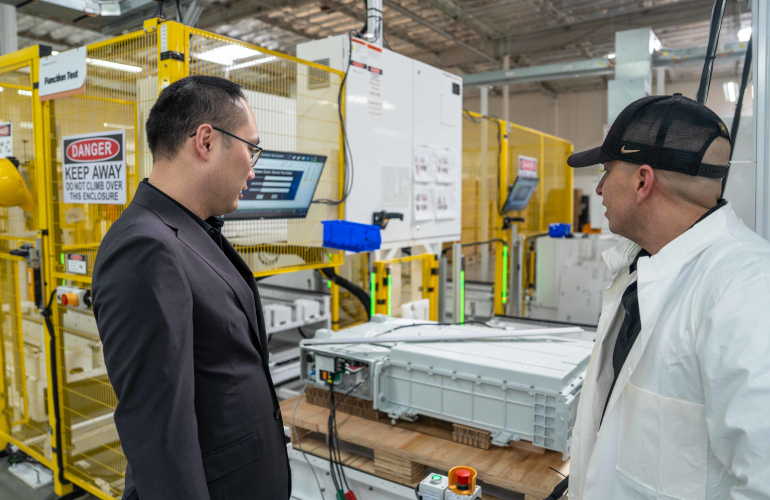
FranklinWH manufacturing in Santa Clara, California. Credit: SPW
Solar Power World was able to tour both California facilities and view residential battery systems in all stages of development. It was surprising to see the home battery circuit boards being printed alongside products for Intel, Microsoft and Google. What was an even bigger surprise was watching robotic arms package eight sturdy, rectangular battery cells into one unit. Up to this point, I had only seen pouch-based cells on assembly lines at LG Energy Solution’s plant in Michigan. FranklinWH uses large-scale prismatic LFP cells in its compact residential systems, a product choice that was molded by supply chain interruptions early in the pandemic.
“We were the first in the industry to use utility-grade LFP prismatic cells. It does pose a challenge: the bigger the cell, the harder to design it into the system,” Lam said. “When we started the company, no one could source anything. We used utility-grade cells. But then we realized there is an additional benefit. Quality is more consistent because [the cell manufacturers] are running 24/7 and supplying all major car manufacturers and utility projects. These cells have been tested millions of times.”
By using more readily available utility-scale cells, FranklinWH was able to leapfrog battery competition in the United States while waiting for residential-focused supply. The company has stuck to using the larger battery cells, packaging them at the start of the line in Santa Clara before they’re assembled into the Oklahoma-made aluminum enclosures and outfitted with circuit boards.
Customer confidence
While the Santa Clara site is under expansion, personnel are still striving for higher efficiency. R&D is a special focus for FranklinWH, and installer feedback is taken seriously. During Solar Power World‘s visit, a California installer joined the tour and suggested alternate knockout locations for easier installation, something that FranklinWH is open to updating.

FranklinWH manufacturing in Santa Clara, California. Credit: FranklinWH
The result is a low failure rate for FranklinWH systems. While most companies aim to keep their return merchandise authorization (RMA) rate below 5%, Lam said FranklinWH’s sits at less than 0.15%.
“From day one, we’ve built FranklinWH around listening to our installers in the field. Their feedback directly shapes how we design and refine our systems,” he said. “That close collaboration, combined with our focus on R&D and manufacturing quality, is what allows us to deliver a product with such a low failure rate. It’s something we take a lot of pride in, because it ultimately means a better, more reliable experience for homeowners.”
That success is because the company focuses on real-world installation efforts, understands today’s market demands and forecasts design trends. While a 13.5-kWh system became the unofficial standard earlier this decade, FranklinWH increased its aPower 2 battery to 15 kWh to better meet household demand with fewer units. The company’s expansion module, aHub, lets batteries integrate with multiple energy sources, including EVs and generators. These additions make FranklinWH a popular choice among installers.
“From our perspective, the system has to work the way installers expect it to in the field,” Lam said. “Too often, what should be a simple final step turns into hours on-site dealing with updates or small issues. We’ve put a lot of focus on removing that friction. Our commissioning process takes about 15 minutes, and that comes down to getting the details right up front. Those details are what make the difference day to day.”
FranklinWH’s future is the United States
Lam said that even with this year’s expected drop in residential solar sales, he remains bullish on home battery adoption.

FranklinWH CEO Gary Lam
“We see the storage attachment rate nationwide increasing. We are forecasting about 40% attachment rate,” he said. “That’s doubling, if not tripling, last year’s number.”
That’s why the Santa Clara facility is growing — so FranklinWH can meet the demand of its favored market. Despite company plans to expand into new international markets, including Japan and Australia, manufacturing will stay in the United States, Lam said.
“What benefits us is our product access to the market,” he said. “Today, the moment our systems roll off our California production line, they can be installed within weeks. And we can immediately incorporate customer and installer feedback. We’re able to shorten our development time, ultimately improving the installer and customer experience.”
FranklinWH proves there is still value in supporting the U.S. solar and storage market with domestic products, providing homeowners with real energy freedom.