


Unless installing solar on every home in a new housing development, it’s rare that a contractor will complete the same project twice. Power needs, landscapes and equipment differ on arrays across the country and even in the same neighborhood. The Solar Power World team thought it’d be interesting to ask solar and storage installers about extreme situations and how best to still make the sale. From building in muddy conditions to working on steep roofs, there’s always something unexpected around the corner. Here’s how installers get jobs done — extremely well.
Residential
Where would you install a battery for a house without a garage?

Credit: Cape Fear Solar Systems
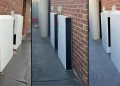
Installing energy storage in our region is rarely as simple as mounting a battery on a garage wall near the utility meter. Many homes in the coastal Carolinas are older and don’t have garages, while some newer homes aren’t designed for first-floor installations. In coastal floodplains, battery equipment often must be installed on the second story to keep it above flood levels. This can mean placing batteries on elevated platforms or in interior utility rooms. While some homes already have suitable spaces, installing equipment there and meeting clearance requirements requires extra care and precision. Our team works closely with homeowners and local authorities to develop and execute a safe, compliant plan.
Not every coastal home needs elevated equipment, and some do have usable garages. Even in those cases, exterior installation may be the best option. Placing the battery near the utility meter is often the most efficient and cost-effective solution and may be the only practical choice depending on the layout of the garage, meter and electrical panel. Fortunately, many modern battery systems are built with durable enclosures and warranties designed for outdoor use and harsh coastal conditions.
-Gabe Amey, Chief Marketing Officer, Cape Fear Solar Systems
How would you pitch solar and storage in an area with a VPP?

Credit: Harvest Power
Solar customers in the Northeast are already adding storage to their systems, but the option of participating in a VPP really cements the deal. VPPs have been a more recent advantage to relay to customers. Through smart software, a system automatically dispatches stored energy during peak demand, stabilizing the grid and earning the customer credits or payments from utilities like Con Edison or Eversource. No extra effort is required, and the customer’s battery charges cheaply off peak and sells high when the grid needs it most. We don’t alter the size of a solar system to take advantage of the VPP benefits; it’s just an added perk for investing in solar and energy storage in our region.
-Carlo Lanza, President, Harvest Power
How do you design a solar project for a household looking to purchase an EV?

Credit: Renova Energy
In our region of southern California, an EV charger installed at home uses, on average, an additional 10 kWh nightly. When designing a residential solar system, we measure loads over a monthly period of time. This additional 300 kWh for an EV is added to that total. The average monthly load on a desert home is around 1,500 kWh, so we add that EV charger load to reach 1,800 kWh. With a non-EV home typically needing at least 11 kW of solar, this would increase the size of a solar array for an EV-owning household to about 13 kW. Adding four solar modules would provide the additional generation to offset the driving patterns of a person using their EV for 12,000 miles annually.
–Vincent Battaglia, CEO, Renova Energy
How would you install panels on a surface steeper than 45°?

Credit: Unity Solar
When we’re faced with a roof pitch steeper than 45°, the first priority is simple: safety. Before any tools come out, our crew performs a full site assessment — evaluating roof condition, access points, tie-off locations and weather exposure.
We dispatch only highly trained, experienced installers for these environments. OSHA-compliant fall protection is non-negotiable: full harness systems, properly-rated anchors, roof brackets, guardrails when possible and controlled access zones. The anchoring and attachment process itself remains structurally consistent with our engineering standards, but the execution requires heightened awareness, balance and coordination.
On extreme pitches, staging and material handling become just as critical as installation. We plan panel lifts carefully, secure materials to prevent sliding and sequence installation to minimize unnecessary movement on the roof. Weather conditions are closely monitored, and we never rush timelines at the expense of safety. Ultimately, the key factors are preparation, skilled labor and mindset. Steep surfaces demand respect, but with the right training, equipment and teamwork, we figure it out safely and efficiently every time.
-Andrew Dubkov, Head of Residential Operations, Unity Solar Group
Large-scale
What site security would you use for a solar project near a major highway?

Credit: Barton Malow
Solar projects are unique in that they are built over several acres, often spanning large, open landscapes that require thoughtful planning and protection. For solar projects located near major highways, robust site security is essential to protect equipment, ensure operational reliability and maintain public safety. Our approach begins with installing tall game fencing around each module region to clearly define boundaries and deter unauthorized access. Appropriately spaced remote camera stations provide continuous monitoring and enable quick detection and response to unusual activity. Clear, visible signage reinforces safety expectations for both team members and the public. Staging material away from the view of local traffic also helps prevent curiosity-driven intrusions. The Lapeer Solar Array, which Barton Malow successfully completed for DTE Energy off Michigan’s Interstate 69, demonstrates how sites can be effectively secured and maintained even when located near a major highway.
-Ryan Johnston, Project Director, Barton Malow
What do you consider in project design and component selection for a project environment regularly experiencing temperatures above 90°F?

Credit: DEPCOM
Thermal management is a critical factor in designing utility-scale solar and energy storage systems — especially in environments where ambient temperatures regularly exceed 90°F. High heat impacts electrical performance, so every component must be evaluated and adjusted for expected operating conditions, not just nominal ratings.
Most electrical components, including inverters and conductors, experience performance degradation at elevated temperatures. For example, inverters may be rated for full capacity up to 30°C (86°F) but often derate by a small percentage for every degree above that. In locations exceeding 40°C (104°F), output can drop below 95%. Conductors face similar constraints; higher temperatures reduce their current-carrying capacity, which requires upsizing or using additional runs.
To compensate, designers must temperature-correct system performance expectations and adjust the quantity or size of components accordingly. This ensures long-term reliability, safety, and optimal energy yield. It’s essential to validate each component’s thermal characteristics directly with the manufacturer. This data-driven approach allows the design team to accurately model system behavior under real-world conditions and ensure consistent, bankable performance throughout the system’s lifecycle.
-Omar Ahmed, VP of Engineering, DEPCOM
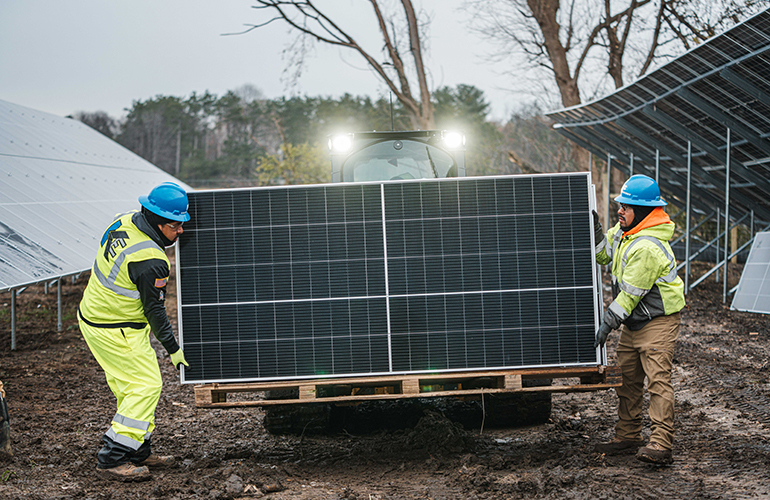
What’s the best way to manage mud/ground conditions when installing a large-scale project?

Credit: Knobelsdorff
Managing mud, snow and poor ground conditions on a large-scale solar project is largely a matter of early planning. When wet-weather rules are not clearly defined in advance, productivity often suffers as crews are forced to “figure it out” in the field.
These conditions can be effectively managed through proactive coordination of deliveries and construction timelines before impactful weather occurs. When weather impacts are unavoidable, mitigation measures may include the use of tracked equipment, additional temporary laydown yards, clearly defined onsite traffic routes and limiting vehicle movement during thawing periods. Taking these steps early helps maintain productivity and reduces risk in challenging ground conditions.
-Erin Brossard, Director of Energy Operations, Knobelsdorff