


For many homeowners, installing rooftop solar panels seems like a smart idea to reduce electricity bills, but the upfront cost and installation complexity can be daunting. These barriers have kept countless households from directly participating in the energy transition.
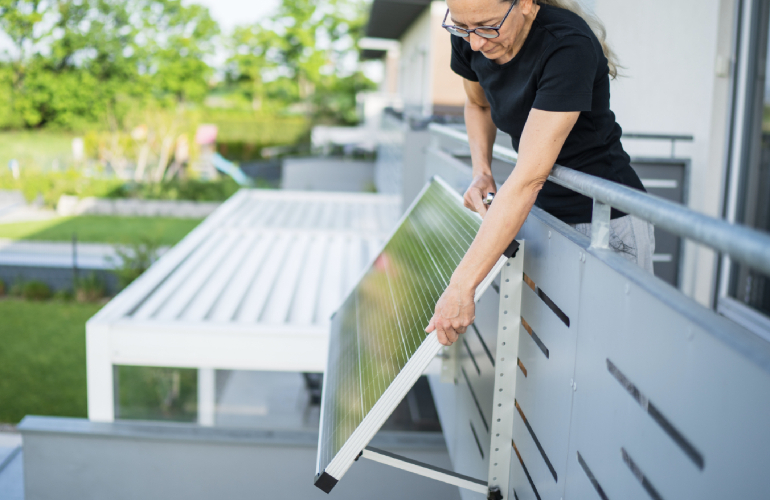
A new option is beginning to change the conversation. Instead of committing to a full rooftop installation, homeowners can place a compact solar kit on a balcony or patio, connect it to a small inverter and plug it into a standard outlet. This concept, often called plug-in photovoltaic (PIPV) or “balcony solar,” is already used in Europe. These compact systems help people offset energy use without the hurdles of traditional rooftop installations. The appeal is clear: lower cost, faster setup and accessibility for renters and homeowners alike.
As promising as this sounds, plug-in solar introduces new safety concerns. Electrical codes and safety standards in the United States were generally built around the assumption that power flows to household outlets in one direction — from the home’s electrical panel to the outlet. When plug-in solar sends power through a receptacle, it can overload wiring or interfere with safety devices like circuit breakers and ground-fault circuit interrupters (GFCIs) — the safety related components that shut off power if they detect a shock risk. These hazards are real and require smart solutions.
While plug‑in solar represents an important step toward broader participation in renewable energy, its success depends on engineered safeguards and updated standards that reflect its unique configuration.

Why plug‑in solar is gaining momentum
In many European countries, plug‑in solar has become a familiar part of everyday life. Small systems on balconies allow households to generate a modest amount of electricity without heavy lifting. Germany alone has registered well over 700,000 of these installations, providing up to 800 W per device — enough to charge a laptop or power a small fridge.
The United States has been slower to embrace this model, and for good reason — power distribution technologies, code enforcement and liability concerns are different compared to Europe. Additionally, standard U.S. outlets weren’t designed to handle electricity flowing back into them. While breakers protect against overloads caused by too much current flowing from the panel to the appliance, it doesn’t “see” the extra current from the solar source feeding back into the outlet. This can overload wires and connected devices, creating fire hazards.
Because these risks fall outside current code requirements, U.S. regulators have been cautious. Until recently, there was little clarity on how such systems could be installed safely or approved under U.S. standards.
But that is beginning to change. In 2025, Utah passed House Bill 340, creating a new category for small plug-in solar systems under 1.2 kW. The bill removes two major barriers: it prohibits utilities from requiring homeowners to get approval before installation, and it eliminates related utility fees.
The legislation allows these devices to connect through a standard 120‑V outlet and requires them to be certified by UL Solutions or another nationally recognized testing laboratory. Because certification requirements will not permit a backfeeding connection to just any standard outlet, that portion of the bill will require clarification as implementation moves forward. Even with that clarification pending, HB340 reduces both administrative hurdles and cost barriers for qualifying plug‑in systems, making them far easier and more affordable for residents to install.
California is now pursuing a similar path with Senate Bill 868, the “Plug into the Sun Act,” which would legalize small plug‑in balcony solar systems by reclassifying them as household appliances. The bill aims to cut energy burdens as California electricity rates have nearly doubled over the past decade.
Vermont is considering similar legislation, and several other states like Maryland, Minnesota, New Hampshire, New York, Pennsylvania and Virginia are exploring ways to make adoption easier while maintaining safety.
However, plug-in solar still introduces hazards that must be addressed before widespread adoption can occur.
Safety challenges of plug-in solar
Consider an electrical vehicle that will charge at home. It can’t be plugged into just any outlet; it needs to take extra measures to safely handle the extra load. This could include a dedicated branch circuit (one circuit with no other outlets where other products can be plugged in, because the EV charger will demand all the current that circuit can provide) or potentially upgraded wiring.
Plug-in solar also requires special consideration of the power distribution wiring. A whitepaper by UL Solutions on the safety considerations for PIPV systems highlights key hazards:
Circuit overload
Power distribution circuits require protection for wiring and devices connected to it, and this is usually in the form of circuit breakers. When a system sends power back into the wiring through an outlet, it adds current to the existing branch circuit without the upstream circuit breaker detecting it. The breaker only monitors electricity flowing in the circuit from the panel, so it can’t account for the extra power being added from the solar unit.
That means the combined current from the grid and the plug-in solar system can exceed what the wires and connected devices were designed to handle — even though the breaker never trips. This hidden overload can lead to overheating, insulation damage and, in the worst case, fire. The risk grows even higher if multiple plug-in solar units are connected to the same circuit because typical home wiring was never evaluated for this kind of reverse power flow.
Shock risk
NEMA 5-15 plugs, standard in the United States, are intended for appliances that draw power from a receptacle and were never meant to carry live power from a generator like a solar panel. When an appliance is unplugged, the blades are de-energized, so they’re considered safe to touch. However, if you unplug a PIPV system while the panels are exposed to light, the system is still producing power, and the metal blades can remain energized at hazardous voltage levels for up to two seconds, which far exceeds the well-established time limit to prevent an electric shock risk. This means anyone handling the plug could come into direct contact with live parts and get shocked.
Additionally, safety standards for PV modules, PV wiring and mounting systems have historically been structured with the understanding that trained persons would design and install the system, and that once installed, the equipment would not be at high risk of mechanical abuse while untrained persons may be exposed to hazardous live circuits due to damaged equipment.
These risks underscore why plug-in solar should not simply be treated like any other appliance plugged into a wall. These systems introduce bidirectional power flow into circuits that were never designed for it, and that changes the safety equation.
So, what is the solution?
Building safer plug-in solar systems
One approach is to install plug-in solar on a dedicated circuit, separate from other household loads. This prevents cumulative current from silently exceeding conductor limits and allows for properly rated overcurrent protection sized for both the solar output and the wiring.
Another solution involves purpose-built receptacles designed exclusively for a plug-in solar connection. Unique outlets could prevent accidental connections to legacy circuits that lack the necessary safeguards. Some designs could even integrate overcurrent protection directly into the receptacle for added safety.
For homes where flexibility is needed, smarter wiring and power control systems offer a path forward. Power control systems (PCS) can actively monitor and regulate combined current from the grid and solar, ensuring total load stays within safe limits — a concept already recognized in electrical codes.
Finally, implementing more rigorous safety requirements for PIPV equipment — such as enhanced mechanical‑abuse testing, limits on exposed conductor lengths, clearer warning labels and more detailed user instructions — could help reduce risks for individuals who install or operate PIPV systems.
To support these approaches, UL Solutions has launched a plug-in solar system testing and certification program, establishing a clear, dedicated testing framework that will help provide a pathway for the safer widespread adoption of this energy generation technology.
The new program is an evaluation based on UL 3700, the Outline of Investigation for Interactive Plug-In Photovoltaic Equipment and Systems and provides a structured approach for evaluating emerging plug-in solar technology. It sets out key safety requirements — such as touch protection, proper grounding and bonding, overcurrent protection and automatic shutdown during power outages — to reduce risks like electric shock and fire hazards. By defining construction and performance criteria, the outline gives manufacturers a clear path to design safer products and offers utilities and regulators the technical basis to assess devices for grid integration.
Collaboration for a safer energy future
Plug-in solar promises simplicity — it creates the impression that solar energy can be integrated into a home as easily as an appliance. But these systems don’t just interact with a wall outlet; they interact with the entire electrical branch circuit to which it is connected.
A plug-in solar system is only truly safe when it is tested and certified as a whole, and a recognized certification like UL 3700 gives utilities and regulators a clear way to review and approve plug‑in solar devices that are shown to connect safely to the grid. It also gives retailers and installers confidence to stock and recommend certified products, helping scale deployment more quickly and consistently.
As the energy transition accelerates, technologies like plug-in solar can empower consumers to participate in a cleaner, more distributed grid. But accessibility must go hand in hand with safety. When the perception of “plug-and-play” meets the reality of rigorous system-level testing, and we also know that the new technology can be used safely, we can then unlock the full potential of this innovation — giving consumers confidence, protecting homes and supporting a resilient energy future.
 Joe Bablo is principal engineering manager for Energy Storage and e-Mobility and principal engineer for Automotive Equipment and Associated Technologies at UL Solutions. He is responsible for technical standards development for electric vehicle (EV) charging, including EV supply equipment, EV chargers and EV couplers. He is a technical representative for all charging-related UL Standards, as well as IEC committees for EV charging. He is also the Code Making Panel 12 Chairperson for the National Electrical Code. Joe is a Distinguished Member of Technical Staff in the W. H. Merrill Society with 30 years at UL Solutions.
 Colleen O’Brien is UL’s technical lead for PV modules and components, bringing three decades of PV experience in cell fabrication, module manufacturing, component reliability, certification, and PV system risk assessment. She represents UL in PV‑related UL Standards, co‑convenes the IEC TC 82/WG 2 committee for PV module standards, serves as an Alternate Member of NEC Code‑Making Panel 4, and is a Distinguished Member of Technical Staff in the W.H. Merrill Society.