



For years, New Hampshire solar developers and their customers have faced one regulatory roadblock after another, making it much harder to connect solar projects to the grid than in neighboring states. New Hampshire is last in the Northeast for solar deployment, mostly due to its outdated interconnection procedures. These rules govern how clean energy projects are connected to the grid and, influence where they can be deployed.

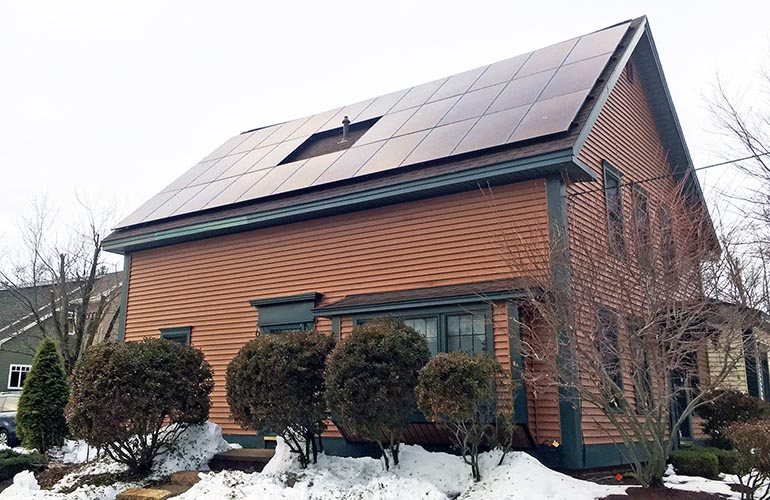
ReVision Energy installed a solar array atop Sullivan Construction in Bedford, New Hampshire, the state’s first LEED Platinum office building.
Developers have experienced firsthand the challenges presented by these regulations — projects stalled, customers left waiting, solar deployment opportunities lost. Which is why they and other clean energy stakeholders were so excited when state regulators opened a process to address these long-standing barriers.
Despite limited guidance from the regulatory agency, a diverse group of participating stakeholders worked together to maintain structure throughout the process. Through collaboration — among utilities, local industry and Clean Energy New Hampshire (CENH), coupled with support from the Interstate Renewable Energy Council (IREC) and Energy Policy Design Institute (EPDI) — the group developed consensus recommendations that could position New Hampshire to become a national blueprint for efficient interconnection procedures.
But it depends on whether the state’s utility regulators and a legislative committee reviewing the draft will keep stakeholder recommendations intact in its final ruling.
With the recent passage of the One Big Beautiful Bill Act, which is cutting tax credits for clean energy and tightening margins for developers, there’s a need for clear interconnection procedures and efficient processes. The focus has now shifted to states to ensure customers and developers can deploy the clean energy they want.
New Hampshire’s interconnection reform process to date offers an example of how state leadership and stakeholder collaboration can drive clean energy progress amid shifting federal policy.
New Hampshire interconnection challenges: Insights from solar developers
For years, New Hampshire’s interconnection rules have posed challenges and frustrations for solar and energy storage developers and their customers.
“Interconnection rules have been a very big challenge in New Hampshire — in large part because there’s really just no rules on the books for projects that are above a megawatt,” said Matt Doubleday with ReWild Renewables, a New Hampshire-based community solar developer. “So, for our projects that are above one megawatt, you’re operating in a space without rules and that’s frustrating because we’re then reliant on what the utility is willing to do — and utilities are resource-constrained.”
Nat Haslett with ReVision Energy, a regional company that develops projects ranging from residential rooftop systems to larger community solar applications, has experienced the difference in New Hampshire’s interconnection process for larger projects.
“We’ve seen some consistent success and effectiveness from existing utility processes around the interconnection of smaller projects,” Haslett said. “We have also seen the absence of clear and robust procedures and timelines have a real detrimental effect on our ability to successfully construct projects in the larger range of the work we do.”
Haslett said that these issues have been particularly pronounced in New Hampshire when compared to Maine and Massachusetts.
“When the interconnection process is working well, those rules are hopefully an afterthought or a small, routine piece of the development process. And when they’re not, they become a critical pain point and a real challenge for getting projects successfully across the finish line.”
Reality of New Hampshire’s current interconnection rules
In 2024, ReWild Renewables joined two other community solar developers and filed a formal complaint with the New Hampshire Department of Energy (NHDOE) regarding interconnection delays. NHDOE’s proceeding (CPT 2024-005) revealed deficiencies in the state’s interconnection procedures.
After reviewing the substance of the complaint, the NHDOE concluded in its final decision that the delays being experienced by the solar developers were not a result of regional utility Eversource Energy disregarding the state’s interconnection rules but were instead a result of a lack of specificity in the rules themselves. The NHDOE stated that the interconnection delays remain “very concerning.”
In the 2023 edition of “Freeing the Grid,” an annual IREC evaluation of states’ interconnection procedures, New Hampshire earned a “D” grade. This grading indicates that the state has not adopted a majority of the interconnection best practices identified in “Freeing the Grid,” such as updating its interconnection procedures to streamline review processes, reducing costs and increasing transparency for interconnection applicants and utilities.
The road to change
Requests for New Hampshire’s interconnection reform began well before ReWild’s complaint in 2024. In 2022, advocates, developers and state leaders came together to address the ineffectiveness of the state’s interconnection rules, which led to the passage of Senate Bill 262 in May that year. The legislation set the stage for change, tasking NHDOE with investigating customer-generator interconnection. Lawmakers urged the agency to look beyond state borders — to evaluate nationwide best practices set forth in IREC’s 2019 “Model Interconnection Procedures,” a resource for refining rules for connecting distributed energy resources to the grid.
By December 2022, the NHDOE had launched a formal proceeding to take on that challenge. Over the next year, stakeholders with a vested interest in interconnection rules weighed in. Clean Energy New Hampshire (CENH), a nonprofit group, led the charge for clearer interconnection rules. By the end of 2023, consensus had formed: Stakeholders agreed change was needed, whether through refining the existing rules or creating entirely new ones.
While NHDOE had not provided clear guidance for reforming interconnection rules, stakeholders still carried this momentum into 2024. In July, Senate Bill 391 was passed, which formally directed NHDOE to establish uniform procedures for interconnecting distributed energy resources to the electrical grid. The legislation cited IREC’s “Model Interconnection Procedures” as a national benchmark.
By November 2024, the rulemaking process was underway. What began as an investigation two years earlier had evolved into a full-scale collaborative effort by a wide range of stakeholders all working toward drafting a new set of interconnection rules that met the needs of all parties.
New Hampshire’s interconnection rulemaking process
While juggling ReWild’s complaint and the interconnection rulemaking process with NHDOE, Doubleday said he realized that the draft rules weren’t going to satisfy all parties involved.
“There [were] a lot of opinions and no sort of middle voice that was leading the effort. It was left up to all of the parties and stakeholders to decide how they wanted to proceed with consensus and non-consensus items in developing these draft rules that would be put forward to the Department of Energy,” Doubleday said.
He said the rulemaking process leaned heavily on the state agency’s resources, which were already stretched thin. CENH served as a convener and IREC offered technical guidance to ensure alignment with nationwide practices during the process.
However, Doubleday said he suspected that bringing in additional support, such as a third party, could help usher the process along. So, Ted Ko, facilitator and executive director of the Energy Policy Design Institute (EPDI) was invited by IREC to observe a meeting to offer insights for improving the process.
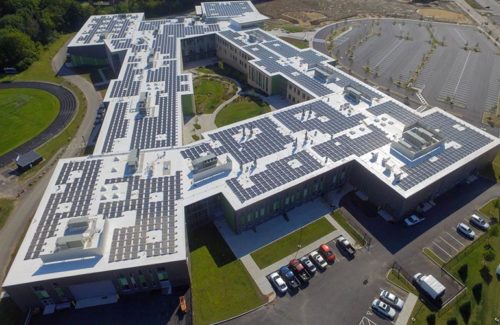
ReVision Energy installed at 912-kW solar array, the company’s largest, at a New Hampshire School.
“I attended one of the meetings and it was immediately clear that the process was stuck with little direction on what to talk about or how to prioritize topics to work on,” Ko said.
EPDI helps state energy agencies and stakeholders design rules that support clean, reliable and fair electricity systems. Ko helped the group identify priorities so it could pick up the pen and begin drafting.
Normally, the state regulatory agency would be responsible for leading the drafting process. So, Jessica Chiavara, senior counsel at Eversource Energy, was tasked to translate everything drafted into a working document. Initial recommendations were modeled after utility tariffs in Massachusetts, but Chiavara discovered that translating those rules to a new state was a large undertaking.
So, it was decided to use IREC’s “Model Interconnection Procedures” as a framework for interconnection rules.
“The IREC partnership was invaluable because Eversource wants a process that works equally well for rooftop solar to a 5-MW solar field and everything in between. Having that aligned objective was incredibly important and very helpful in getting through some of the stickier areas because when you’re drafting rules, you have to take everybody affected or potentially affected by those rules into account,” Chiavara said. “There were some tough conversations, but ultimately stakeholders tried to come up with a process that worked for as many people as possible and in a way that was consistent with New Hampshire policy.”
The rulemaking process concluded with a set of draft rules that satisfied all stakeholders were satisfied with — rules they hope to see implemented with minimal changes by the NHDOE.
“Without the resources that IREC was able to contribute to this process, the industry and utility collaboration to inform the draft rule process would not have made nearly the progress in aligning on a comprehensive draft rule set,” Revision’s Haslett said. “The expertise and facilitation IREC contributed was the critical ingredient in bringing the goodwill the group had assembled into a useful format for further stakeholder discussion.”
Over seven months, representatives of New Hampshire’s three investor-owned utilities, several solar companies and IREC staff met informally to identify areas of consensus and non-consensus. During that period, the NHDOE, with assistance from EPDI, hosted a series of technical sessions to review the parties’ progress with a wider audience of stakeholders. Following that period, parties engaged in a two-month process to develop draft rules.
The final proposed rules were submitted to NHDOE on August 1, 2025. The combination of committed stakeholders and the resources they brought to the table made this progress possible.
“For advocates in other states, my advice would be to start early in building relationships across utilities, regulators and industry groups, and to bring in experienced technical partners — like IREC — who can provide both credibility and clarity,” said Chris Skoglund, director of energy Transition for CENH. “It also helps to ground discussions in concrete examples, such as neighboring state standards, while still giving stakeholders the space to adapt those models to their own context. Above all, patience and persistence matter: These processes are long and detailed, but if advocates can keep stakeholders focused on shared goals — lower costs, reliability and equitable access — the outcomes will be durable and broadly supported.”
Current progress
The draft rules are now under review process by the Joint Legislative Committee on Administrative Rules. If stakeholder recommendations remain intact through this process, New Hampshire residents could soon see their state’s Freeing the Grid grade improve from a “D” to an “A.” For both developers and customers, these reforms would bring a more efficient and transparent path to connecting clean energy projects to the grid.